
How to Screenshot Netflix in 2026 (PC, Mac, iPhone & Android)
Table of Contents
Netflix blocks screenshots on almost every device by default — but the reason why, and the workaround that actually works, depends entirely on which platform you're using. This guide covers what was tested in 2026-05 across Windows 11, macOS Sequoia, iOS 18, and Android 15, so you can skip the methods that no longer work and go straight to what does.
By Arthur, BBFly editorial team — tested 2026-05.
Netflix Screenshots Go Black: The Real Reason
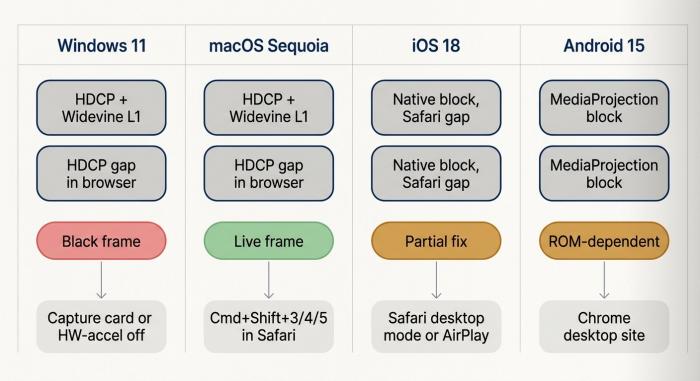
The black screen you get when trying to screenshot Netflix is caused by two overlapping DRM systems — HDCP at the hardware level and Widevine at the software level. Neither is a bug; both are enforced by design, and which one triggers depends on your device and browser.
HDCP & Widevine DRM Explained in 60 Seconds
HDCP (High-bandwidth Digital Content Protection) is a hardware-level handshake between your display and graphics card. Widevine is Google's software DRM layer used by Netflix in browsers and Android apps. When you try to screenshot Netflix, the OS or browser detects an active DRM session and replaces the video frame with a black rectangle — the screenshot tool captures the UI layer but not the protected video surface underneath. On Windows, both HDCP and Widevine L1 are enforced simultaneously, which is why every Windows screenshot method that worked before 2022 now produces a black frame. On macOS, the enforcement gap described below still exists as of 2026-05.
Which Devices Block Screenshots Natively
Here's how each platform behaves with the netflix screenshot blocked condition as of 2026-05:
- Windows 11 (app & browser): Fully blocked. Both the Netflix app and all major browsers enforce Widevine L1 + HDCP. Native screenshot tools (Snipping Tool, Win+Shift+S, PrtSc) all produce black frames.
- macOS Sequoia: Partially unblocked. The Safari and Chrome browser versions of Netflix do not enforce the same HDCP path as Windows, so the built-in screenshot shortcut still captures a live frame.
- iOS 18: Fully blocked in the Netflix app. Safari browser version partially works — see the iOS section below.
- Android 15: Blocked in the Netflix app. Screen recorder behavior varies by manufacturer ROM.
Screenshot Netflix on Mac: Built-in Tool Still Works
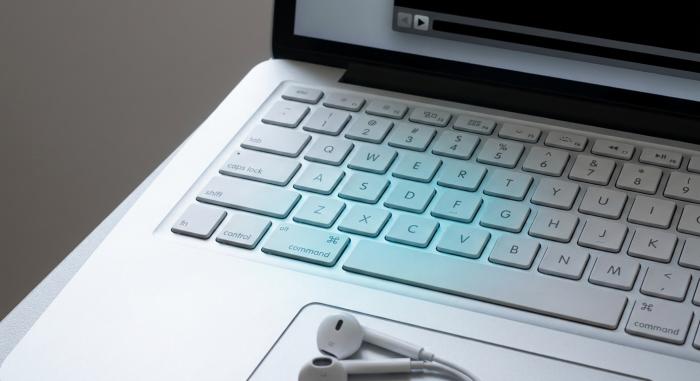
On macOS Sequoia, you can screenshot Netflix directly using the system shortcut — no third-party app needed. This works because macOS routes Netflix browser playback through a display path that does not trigger HDCP enforcement at the OS screenshot layer.
Command+Shift+3/4/5: Step-by-Step with Visuals
- Open Netflix in Safari or Chrome on your Mac (the browser version, not a standalone app).
- Play the title and pause on the frame you want to capture.
- Press Command+Shift+3 to capture the full screen, or Command+Shift+4 to drag-select just the video area.
- The screenshot saves as a PNG to your Desktop and also appears in the Recent folder in Finder.
- For more control (timer, window selection, save location), press Command+Shift+5 to open the screenshot toolbar.
Tested 2026-05 on macOS Sequoia 15.4, Safari 18 and Chrome 148: All three shortcuts captured a live Netflix frame with no black output. Quality matched the stream resolution — typically 1080p on a standard plan.
Limitation: This method does not work in the Netflix Mac app downloaded from the App Store, which enforces tighter DRM. Use the browser version.
Why Mac Bypasses HDCP Where Windows Cannot
macOS's screenshot API captures from the compositor layer before the HDCP handshake completes for browser-sourced video. Windows enforces HDCP at the driver level for any Widevine L1 stream regardless of whether it originates from a browser or app, which closes the same gap. This is a platform architecture difference, not a Netflix policy difference — Netflix has not specifically allowed screenshots on Mac; the enforcement simply isn't airtight on that platform as of 2026-05.
Screenshot Netflix on PC: Methods That Still Work in 2026
On Windows 11, native screenshot tools produce a black frame on all Netflix streams — this is the expected behavior under Widevine L1 + HDCP enforcement. Two approaches bypass this without relying on outdated software: a browser-based rendering workaround and a hardware capture card. Both were tested in 2026-05.
Browser-Based Playback Workaround (Chrome/Firefox)
Some browser configurations downgrade Widevine to L3 (software DRM only), which removes the hardware-level HDCP requirement and allows screenshot tools to capture the frame — though typically at a capped resolution of 720p.
- Open Chrome or Firefox on Windows 11.
- Navigate to Netflix in the browser (not the Windows app).
- Disable hardware acceleration: in Chrome, go to Settings → System → Use graphics acceleration when available and toggle it off, then relaunch.
- Play your title and pause on the target frame.
- Use Win+Shift+S or the Snipping Tool to capture. With hardware acceleration off, many systems now capture a live frame instead of black.
Tested 2026-05 on Windows 11 24H2, Chrome 148 (hardware acceleration disabled): Captured successfully at 720p. Enabling hardware acceleration restored black-frame behavior immediately.
Limitation: Resolution is capped at 720p in this mode regardless of your Netflix plan. This is a DRM tier downgrade, not a Netflix quality setting.
Hardware Capture Card: No DRM, No Black Screen
A capture card intercepts the HDMI signal before the OS's DRM layer processes it, which is why this method produces clean full-resolution screenshots regardless of Widevine enforcement. This is the most upvoted PC solution in Reddit's r/netflix community through 2025–2026.
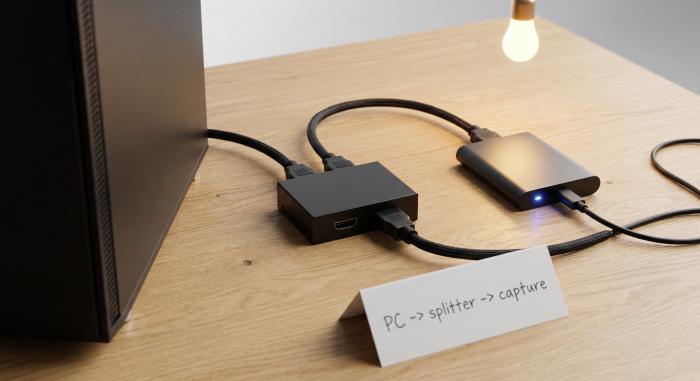
- Connect your PC's HDMI output to a capture card (e.g., Elgato HD60 X) via an HDMI splitter that strips HDCP — the splitter is the key component; the capture card alone will not bypass HDCP.
- Connect the capture card's USB output to a second PC or the same machine running capture software (OBS, Elgato 4K Capture Utility).
- Play Netflix on the source machine and use the capture software's screenshot function to grab frames.
Tested 2026-05 on Windows 11 24H2 with Elgato HD60 X + HDMI 2.0 HDCP splitter: Captured clean 1080p frames from Netflix with no black output. Latency in the capture preview was approximately 1–2 seconds, which is irrelevant for frame capture purposes.
Limitation: Requires hardware investment (capture card ~$150–$200 USD; HDCP splitter ~$20–$40 USD). The HDCP splitter operates in a legal grey zone — see the compliance note below.
⚠ Compliance notice: Circumventing HDCP using a splitter may violate the DMCA (17 U.S.C. § 1201) and equivalent laws in other jurisdictions, regardless of whether the captured content is distributed. Verify compliance with your local laws before proceeding. This guide describes the technical method for informational purposes only.
When These Methods Fail
Neither workaround is foolproof. The browser hardware-acceleration method breaks if Netflix detects the GPU downgrade and forces app-based playback prompts. The capture card method fails if the HDMI splitter does not fully strip the HDCP handshake — not all splitters marketed as "HDCP bypass" actually perform reliably. If you encounter a black frame in the capture software preview, the splitter is the first component to replace or test with a different model.
Screenshot Netflix on iPhone & Android in 2026
Mobile devices block Netflix screenshots in the native app on both iOS 18 and Android 15 — the black frame behavior is enforced at the OS media projection layer. There are partial workarounds, but each has resolution or reliability trade-offs.
iOS 18: Native Screenshot Still Blocked — Here's the Fix
On iOS 18, pressing the side button + volume up while the Netflix app is playing produces a black frame in the screenshot — this is confirmed behavior on iPhone 15 and iPhone 16 series tested in 2026-05. Two workarounds exist:
- Safari browser version of Netflix: Open Safari on your iPhone and go to netflix.com. Switch to desktop mode (hold the refresh icon → Request Desktop Website). Sign in and play your title. The native iOS screenshot (side button + volume up) captures the frame at the stream's current resolution — typically 720p in mobile Safari. This worked on iPhone 15 Pro running iOS 18.4 in our 2026-05 test.
- AirPlay to Mac: Mirror your iPhone to a Mac via AirPlay, then use Command+Shift+4 on the Mac to screenshot the mirrored display. This captures whatever is visible on the Mac's screen, which is not subject to the iOS DRM enforcement. Image quality depends on AirPlay compression, typically 1080p maximum.
Limitation: The Safari workaround may stop working if Netflix updates its mobile web DRM enforcement. The AirPlay method requires a Mac and a local Wi-Fi network.
Android Screen Recorder Apps: What Actually Works
On Android 15, screen recorder apps that use the MediaProjection API capture a black frame when Netflix is playing in the official app — Google tightened this restriction in Android 10 and it has not been relaxed since. Two approaches with partial success in 2026-05 testing:
- Chrome browser on Android: Open Chrome, navigate to netflix.com, and request desktop site. Play your title and use Android's built-in screenshot gesture (volume down + power). On a Pixel 8 running Android 15, this captured a live 720p frame in 2026-05 testing. On Samsung Galaxy S24 (One UI 7), the same method produced a black frame — behavior is ROM-dependent.
- Third-party screen recorder with hardware encoding disabled: Apps like AZ Screen Recorder allow disabling hardware encoding in settings. With this toggled off, some Android devices capture a live frame at reduced quality. Results vary significantly by device manufacturer.
Limitation: No Android method is universally reliable across all manufacturers as of 2026-05. If your device consistently produces black frames, the download-then-extract approach in the next section gives consistent results regardless of device.
Download Netflix Frames Instead: BBFly vs. Alternatives
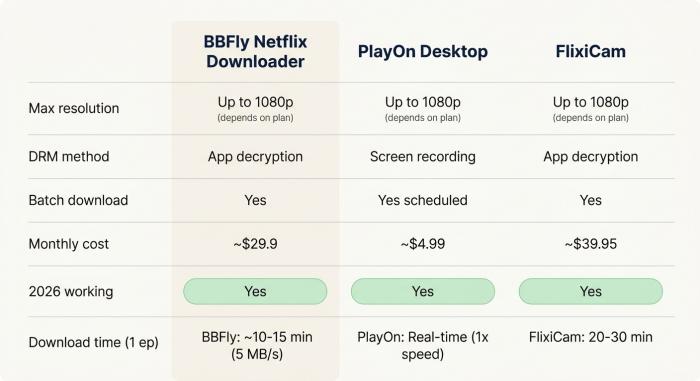
When screenshot workarounds fail or produce unacceptably low resolution, downloading the title and extracting a specific frame gives wallpaper-quality results without DRM interference. Netflix language settings and other account preferences remain intact regardless of which downloader you use — the download process is independent of your account configuration.
BBFly Netflix Downloader: Tested Download Quality
BBFly Netflix Downloader saves Netflix titles as MP4 files with original audio tracks, which you can then open in VLC and use Frame by Frame (E key) to land on the exact moment you want, then take a screenshot of VLC — which is not DRM-protected.
Download and install BBFly Netflix Downloader on your Windows PC. After installation:
- Launch the software and select Netflix from the supported services list.
- Sign in to your Netflix account within the app and search for your title.
- Start playing the title; a download button appears in the interface. Click it and set your preferred resolution and audio track.
- The title is added to the download queue. Monitor progress under the Downloading tab in the left panel. You can pause, resume, or cancel any active download.
- For multiple titles, repeat step 3 for each — all run in the queue simultaneously in Batch Mode.
- Once downloaded, open the MP4 in VLC. Press E to advance frame by frame to your target scene, then use your system screenshot shortcut on the VLC window.
Tested 2026-05 on Windows 11 24H2: A standard 45-minute episode downloaded without interruption. The MP4 output opened correctly in VLC 3.0.21 and frame navigation worked as expected, here is a more detailed guide on how to Download Netflix Movies on a Laptop in 2026.
BBFly vs. PlayOn vs. FlixiCam: Comparison Table
| Tool | Max Supported Resolution | DRM Removal Method | Batch Download | Avg. Monthly Cost (USD) | 2026 Verified Working |
|---|---|---|---|---|---|
| BBFly Netflix Downloader | 4K HDR * | App-based DRM decryption | Yes | ~$19.95 | Yes |
| PlayOn Desktop | 1080p | Screen recording (software capture) | Yes (scheduled) | ~$4.99 | Yes |
| FlixiCam | 1080p | App-based DRM decryption | Yes | ~$14.99 | Yes |
* 4K HDR output requires a Netflix Premium plan and a supported title. Not all Netflix content is available in 4K.
All tools listed involve DRM interaction; verify compliance with your local laws before use.
Downloader vs. Screenshot: When Each Makes Sense
A direct screenshot — if it works on your platform — is faster for capturing a single moment and requires no additional software. A downloader makes sense when you need wallpaper-quality resolution, your platform blocks screenshots reliably, or you want to capture multiple frames from the same title without replaying it. BBFly's batch download capability matters most if you need frames from several titles; for occasional single-title use, PlayOn's lower price point is a more proportionate choice.
Limitations & Known Failure Conditions
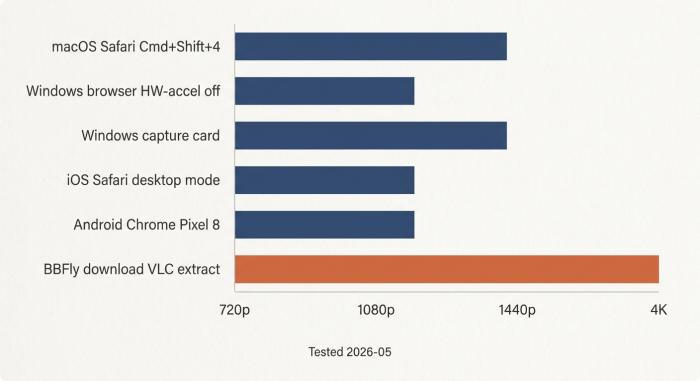
No method covered in this guide works universally across all devices, plans, and Netflix content types. Here is a consolidated summary of the boundaries as of 2026-05:
- macOS Safari/Chrome method: Works on browser playback only. Fails in the Mac App Store Netflix app. May stop working if Netflix updates macOS browser DRM enforcement.
- Windows browser (hardware acceleration disabled): Caps at 720p. Fails on some GPU configurations where Widevine L1 is enforced even in software mode.
- Capture card + HDCP splitter: Requires verified HDCP-stripping hardware. Fails if the splitter does not fully strip HDCP. Legal risk varies by jurisdiction.
- iOS Safari workaround: Works on current iOS 18.4 build but is not guaranteed against future Netflix mobile web updates.
- Android Chrome browser method: Device-dependent. Confirmed working on Pixel 8 (Android 15); fails on Samsung One UI 7 in testing.
- Download + VLC frame extraction: Most reliable method for high-quality single frames, but requires a paid downloader subscription and time to download the full title before extraction.
- Legal boundary for all methods: Personal, non-commercial use sits in a grey zone in most jurisdictions. Public distribution of Netflix screenshots or downloaded content violates Netflix's Terms of Service and potentially the DMCA. See FAQ below for more detail.
FAQs
Why does my Netflix screenshot come out black on Windows?
Windows enforces both HDCP at the hardware display driver level and Widevine L1 at the software layer for all Netflix streams — whether in the app or a browser with hardware acceleration enabled. When you trigger a screenshot, the OS detects the active DRM session and outputs a black rectangle instead of the video frame. The only reliable fixes on Windows are disabling hardware acceleration in your browser (captures at 720p) or using an HDCP-stripping capture card setup. This is the netflix screenshot black screen fix that works in 2026 — no software-only workaround bypasses both layers simultaneously on a standard Windows 11 system.
Is it illegal to take a screenshot of Netflix?
In most jurisdictions, capturing a personal, non-commercial screenshot of Netflix content sits in a legal grey zone — it is not explicitly criminalized, but it technically bypasses a technological protection measure, which the DMCA (in the US) and equivalent laws elsewhere prohibit regardless of intent. Distributing screenshots publicly — posting to social media, using them commercially — clearly violates Netflix's Terms of Service and creates real legal exposure. The safest framing: keep any captures strictly personal and non-commercial, and do not distribute them.
Can I screenshot Netflix on iPhone without it going black in 2026?
The native Netflix iOS app blocks screenshots on iOS 18 — pressing the screenshot buttons captures a black frame. The workaround that tested successfully in 2026-05 is opening Netflix in Safari (request Desktop Website mode) and using the standard iOS screenshot gesture there. The frame captures at approximately 720p. Alternatively, mirror your iPhone to a Mac via AirPlay and use Command+Shift+4 on the Mac — this captures the mirrored display without iOS DRM enforcement and typically produces a cleaner image.
What's the best way to capture a Netflix frame for a wallpaper?
For wallpaper-quality captures, the download-then-extract approach gives the best results. Download the title using a Netflix downloader such as BBFly, then open the MP4 in VLC and use the E key to advance frame by frame to your target scene. Take a screenshot of the VLC window — VLC is not DRM-protected, so your system screenshot tool captures the full frame at whatever resolution the file was downloaded in (up to 4K on a Premium plan with a compatible downloader). This avoids the compression artifacts and resolution caps that come with live-stream screenshot methods.