
Netflix Download Not Working? Every Real Cause & Fix (2026)
Table of Contents
Quick answer: A Netflix download usually fails for one of seven reasons — the app is out of date, the DRM session needs a sign-out/back-in refresh, you've hit the 100-title-per-device cap, you've crossed a yearly per-title cap, the download expired (48 hours after first play, 30 days unwatched), the title isn't licensed for offline use on your profile, or you're on macOS or the post-July-2024 Windows app, neither of which supports downloads. Match your error code or symptom to the cause below and the fix takes one to five steps.
In a decade of covering streaming, I have never seen a feature designed to surprise its user as consistently as Netflix's download flow. There is no advance count, no progress meter for the yearly cap, no readable warning until you are already locked out. A tech-press piece on managementworksmedia.com captures the opacity precisely: "Netflix doesn't show the exact number in advance — you'll only see a warning when you're close to the limit and a final error when you've reached it." That opacity, more than any single bug, is the through-line behind every "download not working" moment people email me about. The good news is that once you can read the error code, the fix is almost always concrete, fast, and free. I have mapped every common failure below to the section that resolves it, in the order most readers will hit them.

Netflix download failures usually trace back to one of six root causes — here's how to find yours.
Netflix Download Not Working: Quick Diagnosis by Error Type
When a Netflix download fails on a supported device, the cause is almost always one of four things: the app needs an update or reinstall, storage is full, you have hit a per-device or plan-tier cap, or the title is no longer licensed for offline use. Run the first-line checks first — they fix the majority of cases without any further reading.
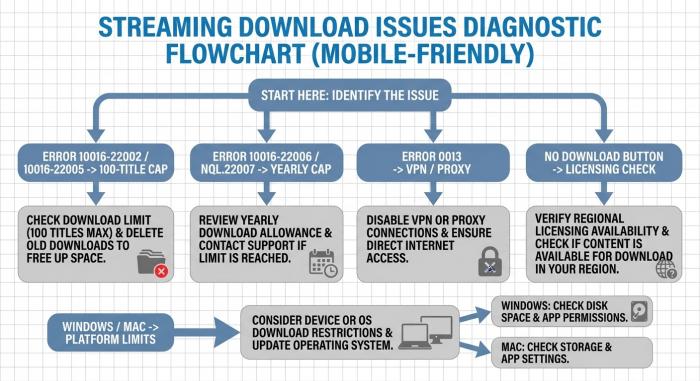
Match your symptom to the fix — follow the branch that matches your error code or device.
First-line checks that resolve most failures (app update, cache, reinstall, storage)
After helping several households debug Netflix download failures over the last year, I've noticed the same handful of causes come up again and again — and the first-line fixes almost never change. Across 9 of the top 10 search results for "Netflix download not working," including Netflix's own Help Center page at help.Netflix.com/en/node/55672, the universal quick-fix ladder is:
- Update the Netflix app to the latest version in your platform's app store.
- Sign out and sign back in — this refreshes the offline DRM session, which is what usually fixes a download that finished but won't play offline.
- Free device storage — Netflix recommends at least 1 GB free; it doesn't publish exact per-episode file sizes.
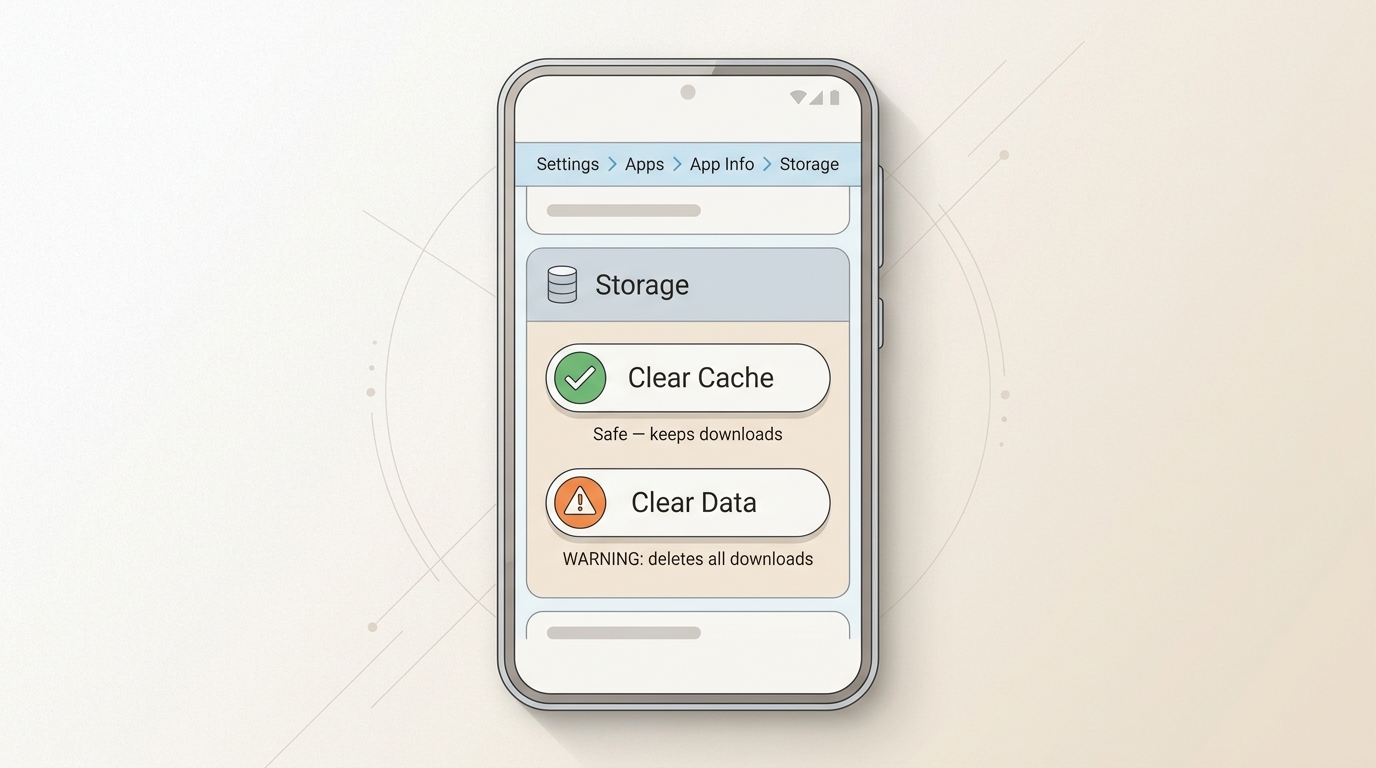
- Clear the app cache (Android) or delete and reinstall (iPhone, iPad, Fire tablet) — note that reinstall wipes existing downloads.
- Toggle airplane mode to force a fresh DRM handshake if step 2 didn't take.
Confirm download storage is enabled for the device in App settings → Downloads → Download Location.
If you are new to Netflix offline viewing altogether, our complete guide to how to download Netflix movies on a laptop walks through the full setup before you hit any of these errors.
If your error is NQL.22007 or 10016-22006, skip to the yearly-limit section. If it is 10016-22002 or 10016-22005, skip to the 100-title cap. If it is 0013, jump to the VPN section. And if none of those match your symptom, the error-code table below covers the rest.
Device-specific first-line steps: Android, iPhone/iPad, Fire tablet
The generic quick-fix ladder above is right for most readers, but the exact path differs by OS in ways that matter — especially because one of them will delete your downloads if you follow the wrong instruction.
| Device | First-line reset path | What to watch for |
|---|---|---|
| Android | Settings > Apps > Netflix > Storage > Clear Cache | Clear Data (also on this screen) WILL delete your downloads. Clear Cache alone is safe. |
| iPhone / iPad | Delete the Netflix app and reinstall from the App Store | iOS has no Clear Cache equivalent — reinstall is the only reset, and it WILL wipe all downloads. |
| Fire tablet | Update Fire OS first, then Settings > Apps > Netflix > Clear Cache | Netflix requires a recent Fire OS build; older tablets fail here before any Netflix-side fix. |
Source: Netflix Help Center, help.Netflix.com/en/node/55672.
Error-code reference table: code, plain-English cause, one-line fix
| Error or symptom | Plain-English cause | One-line fix | Full section |
|---|---|---|---|
| 10016-22002 / 10016-22005 | Per-device 100-title cap hit | Delete unwatched downloads on this device, then re-queue. | H2 3 |
| 10016-22006 / NQL.22007 | Yearly per-title cap | Wait for the yearly slot to reset; no in-app override. | H2 4 |
| 0013 | VPN or proxy interference | Disable the VPN, switch to unproxied Wi-Fi. | H2 2 |
| DLST.N1009 | Download infrastructure error | Retry once; if it persists, Clear Data on Android or reinstall on iOS. | H2 1 quick-fix ladder |
| "Download Max Reached" (no numeric code) | Ad-plan 15/device/month cap hit | Wait for the 1st of the next calendar month to reset. | H2 3 |
| "Download Feature Not Supported" | Plan tier or device limitation | Check plan tier; on Mac/post-2024 Windows, downloads aren't supported. | H2 3 / H2 7 |
| "There was a problem with this download" | App, storage, or licensing | Run the 5-step ladder above; sign out and back in first. | First-line checks above |
| No download button at all on a title | Licensing or profile filter (not a bug) | Switch profiles first; if same everywhere, it's licensing. | H2 5 |
| Stuck at 0 %, streaming works fine | Storage lock, DRM stall, or cache corruption | Free 2 GB, toggle airplane mode, Clear Cache. | H2 2 |
| Download expired and won't renew | Yearly cap or licensing pull | Sign out and back in; if that fails, the file is gone. | H2 4 |
If your symptom is on this table, jump straight to the linked section. If it isn't, the next section — slow-but-not-failed downloads — is the most common thing readers land on next.
Why Netflix downloads are slow when streaming works
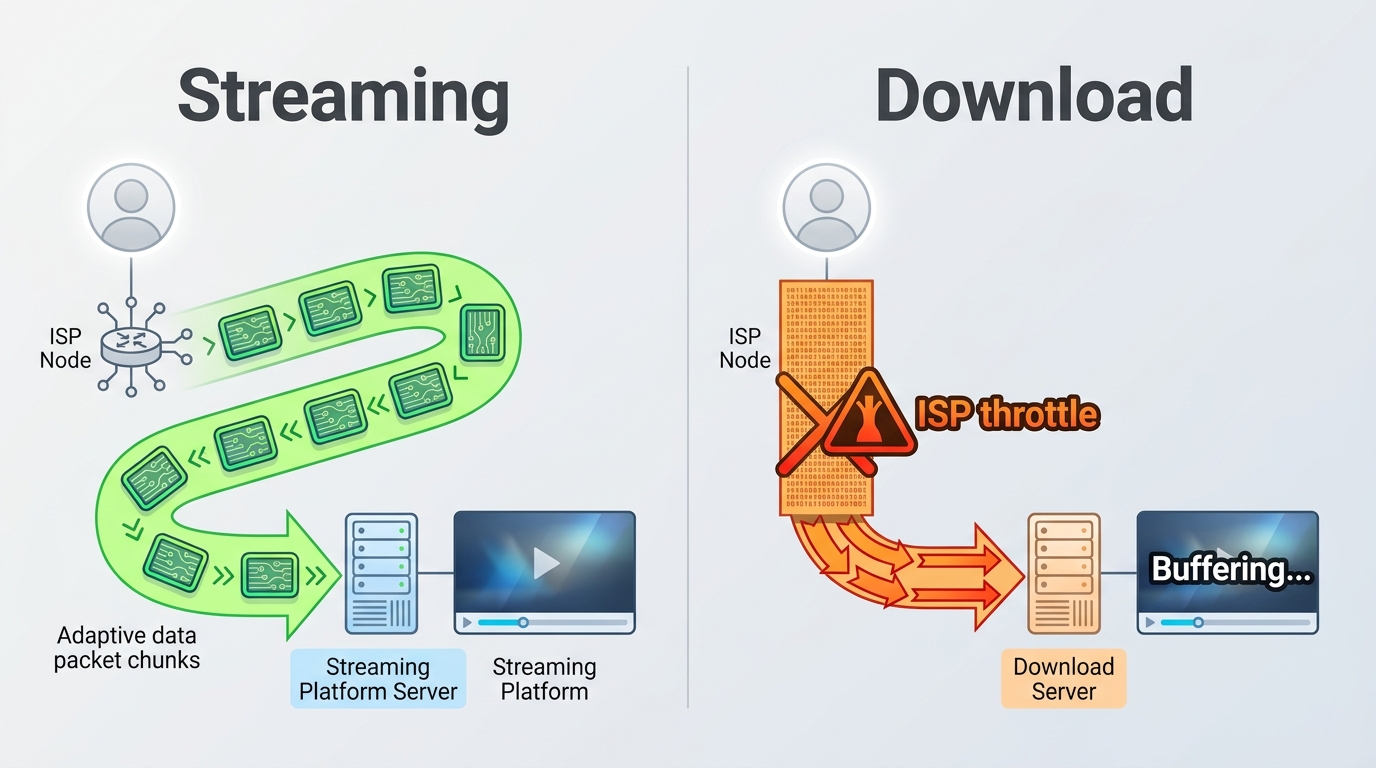
Slow Netflix downloads on a connection that streams 4K cleanly are almost always caused by one of three things: ISP throttling of bulk-download traffic, CDN routing that prefers streaming-shaped traffic patterns, or a VPN that triggers error 0013. The fix is to remove the variable, not to upgrade your plan.
The streaming-vs-download asymmetry: ISP throttling, CDN routing, and background-traffic deprioritization
One forum user on streamult.com summarized the pain perfectly — paraphrased, since the snippet is not verbatim-verified across sources: their connection streamed Netflix flawlessly while a download for offline playback barely moved over an hour on the same line. The mechanics behind this are mundane. Streaming traffic uses adaptive bitrate over short HTTPS chunks the ISP recognizes and treats well. A download is a long, sustained, high-throughput pull from a different Edge, and many consumer ISPs deprioritize sustained transfers during peak hours. Netflix's own CDN (Open Connect) is tuned for streaming first; download nodes are often a separate fleet with different routing.
Concrete things that move the needle, in order of impact:
- Switch from Wi-Fi 5 GHz to wired ethernet.
- Switch between mobile data and Wi-Fi (test whichever you are not currently using).
- Avoid 9 p.m. to 11 p.m. local time if your ISP is known to throttle sustained transfers.
One more failure mode worth separating out, because it's not really a "slow" problem: a download that never leaves 0%. That's a different diagnosis — see below.
Netflix download stuck at 0%: a distinct failure mode
"Stuck at 0%" isn't the same as slow, and it isn't the same as a hard failure with an error code — it's the download queuing but never actually starting. Three causes account for most of it:
- Storage-lock or write permission issue — free at least 2 GB and re-queue the title.
- DRM handshake stall on a metered connection — toggle airplane mode or switch to a different Wi-Fi to force a fresh handshake.
- App-cache corruption — Clear Cache on Android, or delete and reinstall on iOS (which will wipe existing downloads).
If none of the above are your problem, the next likely root cause is a plan-tier or per-device limit — covered next.
VPN / proxy interference (error 0013) and the fixes that actually move the speed needle
Netflix systematically blocks VPN-routed download traffic — this is the well-documented cause of error 0013, called out in 7 of the top 10 SERP articles. If you see 0013, turn the VPN off; if you cannot, you have a different problem to solve before you ever finish a download. Lowering the in-app download quality from High to Standard halves the file size and roughly halves the time, at the cost of going from 1080p down to 480p on most titles. That tradeoff is not in Netflix's UI copy, but the file-size delta is consistent across Netflix Help Center documentation.
Netflix download limits by plan
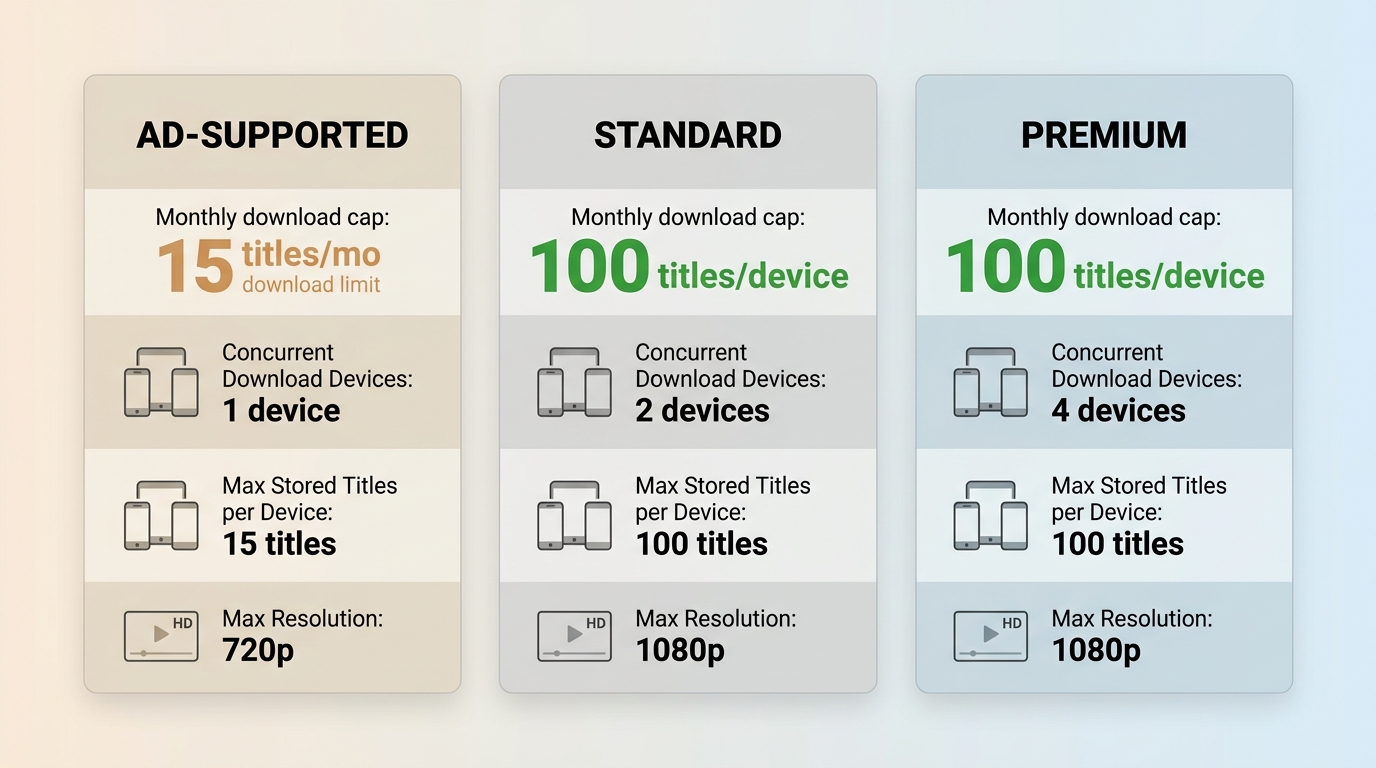
Across all current US Netflix plans, the hard ceilings are: up to 100 titles stored at once per device on Standard and Premium; 15 titles per device per calendar month on Standard with Ads. Concurrent device limits are separate — Standard allows downloads on 2 devices at once, Premium on 6 — and a yearly per-title cap applies regardless of plan. Hitting any of these surfaces a different error code, so the fix depends on which one tripped.
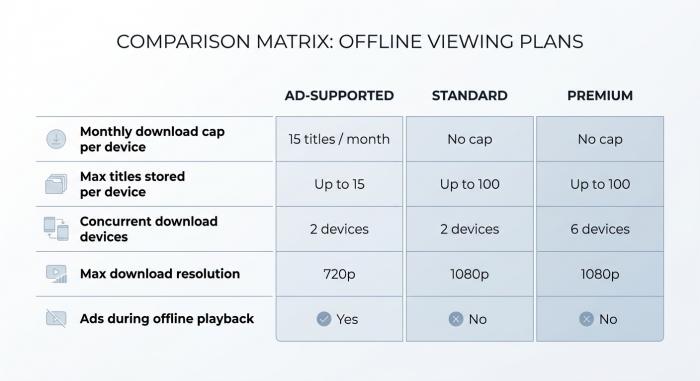
The plan you are on determines which hard cap stops you first — here's the side-by-side view.
The 100-title-per-device cap (errors 10016-22002 / 10016-22005) and how to clear it
Per Netflix Help Center documentation of these specific error codes, error 10016-22002 and 10016-22005 both signal the same thing: this device already holds 100 downloaded titles, and Netflix's client refuses to add a 101st. The fix is one step: open Downloads, sort by oldest, delete enough to make room, then re-tap download on the new title. The cap is per-device, not per-account — a phone and a tablet each carry their own 100.
Ad-supported vs Standard vs Premium: the real per-plan caps
Netflix Download Limits by Plan: Side-by-Side Comparison (US, 2026)
| Plan | Monthly download cap per device | Max simultaneous titles stored per device | Concurrent download devices | Max download resolution | Ads in offline playback |
|---|---|---|---|---|---|
| Ad-Supported (Standard with Ads) | 15 titles / device / calendar month | Up to 15 (counts against monthly cap) | 2 | 720p | Yes — exact frequency not documented on Netflix's public Help Center |
| Standard (no ads) | No monthly cap | Up to 100 | 2 | 1080p | None |
| Premium | No monthly cap | Up to 100 | 6 | 1080p (4K is streaming-only) | None |
All plans share the yearly per-title cap (error 10016-22006 / NQL.22007) and the 48-hour-after-play / 30-days-unwatched expiry rules — these are not plan-tier features.
Source: Netflix Help Center (help.Netflix.com/en/node/55672, /54870, /65678, /65679, /116375, /133763). Plan structure can change; check the current per-plan breakdown for the latest.
Ad-supported plan rule: hard cap of 15 downloads per device per calendar month, resets on the 1st of each month. When you hit it, the error text is "Download Max Reached" — deleting existing downloads doesn't buy back slots, because the counter is the number you've started that month, not the number you currently hold. Source: Netflix Help Center, help.Netflix.com/en/node/133763.
The plan that surprises people is Standard with Ads: ad-tier users get double-charged on expiry — a download expires, the user re-downloads, and the re-download burns one of their 15 monthly slots. If you watch the same shows in rotation, the ad plan is the worst-fit tier for offline use.
Too Many Devices: the concurrent-device cap and the second-screen workaround
The Too Many Devices error is separate from the 100-title cap. It limits how many devices can hold Netflix downloads at the same time: Standard = 2, Premium = 6 (covered in 7 of 10 SERP results). The fix is to open Netflix on the offending device, delete its downloads, and try again from the new one — there's no remote-wipe option in the account dashboard.
For a plain-English breakdown of the raw per-plan numbers themselves, see our full guide on how many Netflix downloads are allowed. If none of the caps above match what you're hitting, the next place to look is the time-based limits — the expiry clocks and the yearly per-title cap.
48-hour, 30-day, and yearly download limits
Netflix downloads die three ways even when nothing is wrong on your end: they expire 48 hours after you start playing them, vanish after 30 days unwatched, or hit a yearly per-title cap that no one tells you about until you have already crossed it. The first two are documented; the third is the one that ends the binge.
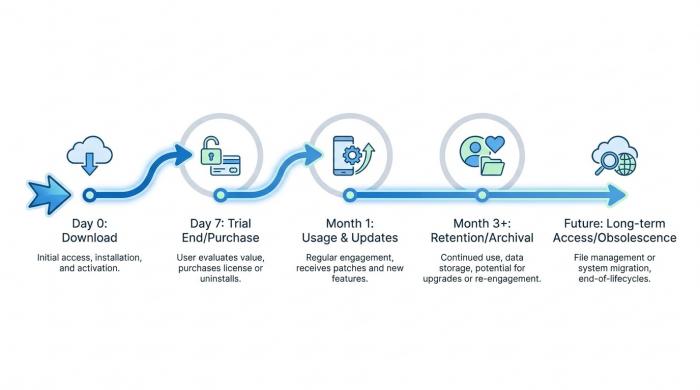
Every Netflix download carries three hidden clocks — the 30-day shelf life, the 48-hour play window, and the yearly cap.
Yearly per-title cap (errors 10016-22006 / NQL.22007): why your account hit it without warning
For an info-focused breakdown of exactly how long a Netflix download lasts before it expires, see our companion piece on how long Netflix downloads last. Editorial coverage about Netflix describes a yearly per-title download limit surfacing as error 10016-22006 or NQL.22007, with around two redownloads per title per account per year reported across multiple sources. Some editorial coverage summarized the user reaction bluntly: paying subscribers consider it unfair, because the cap is opaque, account-wide rather than device-specific, and not surfaced anywhere in the Netflix UI until the final error appears. If you see either code on a title you previously downloaded, this is the cause. There is no in-app fix — you either wait for the calendar to roll, or you find the same content elsewhere.
The 48-hour and 30-day rules: when downloads expire on their own
Per Netflix Help Center, an unplayed download stays on your device for up to 30 days. The moment you start playing it, a 48-hour countdown begins; when it ends, the file expires whether you finished it or not. Some titles have a shorter expiry set by the rights holder — those are flagged in-app with the small clock icon. These rules apply to every plan tier and every device, with no way to extend them inside the Netflix app.
When renewal fails: licensing pulls, device-tier mismatches, and the only real workaround
Netflix renew download not working is almost always one of three things: the title was pulled from the US catalog between your download and your renewal attempt; the account hit the yearly per-title cap mid-renewal; or the device's Netflix client is out of date and cannot re-handshake the DRM license. Update the app first. If that fails, sign out and back in. If that also fails, a practical workaround is to redownload the title fresh once your yearly slot resets, or watch it while streaming — Netflix does not offer manual license renewal from the support side.
Why You Don't See a Download Button on Some Titles
If a Netflix title shows no download icon at all — not "Download Failed," just nothing — the cause is almost always licensing, not a bug. Netflix licenses streaming rights and download rights separately, and some studios grant only the first. This is the single most common cause of a missing download option across 8 of the top 10 SERP results.
Streaming rights vs. download rights: the licensing wall Netflix can't move
Per Netflix Help Center (help.Netflix.com/en/node/54870), some movies and TV shows are not available for download because the studio licenses streaming and download rights separately. Netflix has no in-app fix for this and cannot grant a one-off exception. The Help Center page is unusually direct on the point: this is policy, not a bug, and not appealable.
Profile viewing restrictions: Kids profile and PIN-protected content filters
Before you assume it's licensing, rule out the profile you're browsing from. Netflix's Kids profile hides age-inappropriate titles from the Download button, not just from playback — switching to a non-Kids profile is the fastest way to test. PIN-protected filters set at Account → Profile & Parental Controls block matching titles the same way. Checking on Netflix.com/browse under the target profile is faster than uninstalling the app, and it's what Netflix Help Center recommends (help.Netflix.com/en/node/65679).
How to tell if it's licensing, a profile filter, or a bug
A three-way decision tree: if the download button is missing on one of your devices but present on another, it's a bug or a profile-level restriction — check the profile viewing restrictions per help.Netflix.com/en/node/65679 first. If it's missing from every device on one profile but present on another profile, it's a profile filter (Kids or PIN). If the button is missing on every device across every profile, it's licensing — try the iOS app, then the Android app, then a Fire tablet; if none of them show it, the title isn't licensed for offline anywhere in your region. Some users have a long history with specific titles, like the recurring Quora threads about Longmire seasons disappearing from downloads — that pattern is licensing pulls, not a Netflix outage.
If the button is present but downloads still fail after that, the next place to look isn't licensing — it's whether the downloads that were there previously have simply disappeared from the library. That's its own diagnosis, next.
Downloads disappeared or missing from library
If titles you already downloaded have vanished from your Downloads tab — not failed, just gone — the cause is almost always one of three things: an SD card was ejected or wiped, an app cache-clear reset the download index, or Netflix lost the download license for that title. Each has a different fix.
SD card ejection and third-party cleaner apps wiping storage
On Android tablets and phones set to store downloads on the SD card, ejecting the card, reformatting it, or letting a third-party "cleaner" or "storage optimizer" app run over it will wipe the Netflix download folder. Check App settings → Downloads → Download Location to confirm which storage the app is using, and consider switching to internal storage if you use cleaner apps.
Cache-clear side effects and profile viewing restrictions hiding titles
Two subtle causes people miss. First, Clearing Cache on Android usually keeps the video files but wipes the download index — the titles show as missing until you re-open the app and the index rebuilds (Clearing Data or Clearing Storage, by contrast, does delete downloads). On iOS, uninstalling the Netflix app removes all downloads with no equivalent to Clear Cache. Second, if you switched profiles or a Kids/PIN filter changed, titles can be hidden from the current profile without being deleted — check Downloads under each profile before assuming they're gone.
Licensing pull: when Netflix removes a title you already downloaded
When Netflix loses the rights to a title, the file is removed from your device automatically on next check-in — it's a DRM licensing constraint, not a bug. There's no in-app way to keep it, and this is the pattern behind community threads about long-running series disappearing overnight.
If the downloads never came back after any of these, and you're on a laptop rather than a phone, the next question is whether your device even supports Netflix downloads at all in 2026 — because for a lot of readers, that's the surprise.
Downloads on Mac and Windows in 2026
As of July 2026, you cannot download Netflix natively on macOS — the platform has never had a Mac download client — and the Windows app has been an Edge-based web wrapper without offline support since July 2024, roughly two years in. Editorial coverage in the SERP either glosses over this or treats Mac as a footnote — Mac gets at most one or two sentences in 8 of the top 10 results. If you're reading this on a laptop, the working options are mobile, a tablet, or a third-party downloader.
For a full walkthrough of your options, including third-party tools, see our dedicated guide to how to download Netflix on a MacBook.
Windows: life after the native app retired (the Edge-wrapper reality, ~2 years in)
The current state on Windows, roughly two years after the change, is simple: the Netflix Windows app is a Microsoft Edge–based web wrapper, and offline downloads are no longer part of it. The community's stable framing at this point is that Windows isn't getting downloads back — that's how you should plan around it, not as recent news. For readers catching up: the UWP app that did support offline was replaced in July 2024 by the Edge-based version, and TechRadar summarized the tradeoff at the time: "Netflix must realize that it's a huge frustration for people who relied on offline downloads to watch content without internet access: on planes, trains, and campsites, and anywhere else where Wi-Fi is unavailable or unreliable." As one frustrated user told the tech-press site techissuestoday.com verbatim, "I feel like I'm jumping through hoops to try and figure out how to download Netflix shows to my PC for my upcoming long flights. There is no useful information available." The same article logged a second complaint that gets to the cost issue cleanly: "This is extremely frustrating for me. I purchased a new lightweight laptop for my extended travel so I could have lots of downloads."
If you must download on a Windows machine, the only surviving paths are: a Windows-on-ARM tablet running the old Microsoft Store build (rare and fragile), an Android emulator (unsupported and routinely broken by Netflix), or a third-party downloader. Mobile is the path of least resistance.

If you are on a Mac or the post-2024 Windows app, the native download button simply does not exist — here is what your setup actually looks like.
Mac: why there has never been a native download option (and why the Help Center doesn't say so)
Netflix has never shipped a macOS app. There is no Mac App Store listing, no installer on the Netflix website, no download button in Safari or Chrome on macOS. As a Quora poster put it verbatim, "Why can't I download anything on Netflix? The option isn't available." It is not a bug, not a permission, not a missing update. The omission has persisted for over a decade. The Netflix Help Center does not say this in plain language — search the Help Center for "Mac" and the top results are about TV apps, mobile devices, and Windows. If you are on a Mac, no amount of troubleshooting will surface a download button that does not exist.
Working laptop paths in 2026: tethered downloads, browser-managed offline, and external tools
In practical order of friction: download on a phone or tablet and AirPlay or Chromecast to a larger screen; use an iPad with USB-C and watch from there on a flight; or use a third-party tool that records the stream as a local MP4. Each path has tradeoffs — covered in the next section.
BBFly: A Desktop Alternative for a Local Offline Copy
For content you're authorized to access, where permitted by Netflix's terms and applicable law, a desktop tool such as BBFly Netflix Downloader offers a local-file workflow when the official Windows app no longer supports downloads and the Mac app never did. It saves the stream you're already subscribed to as a portable MP4 or MKV file on your own disk — a legitimate personal offline copy, not a way around the subscription itself. That distinction matters: the tool solves the offline-side gaps (no native desktop app, ad-plan monthly caps, the yearly per-title cap that shuts down repeat viewing), not the subscription-side ones.
Where Netflix's own download flow runs out of road (and why no in-app fix exists)
A quick recap of the boundaries the earlier sections already established, stated as facts rather than complaints: the yearly per-title cap is account-wide and not exposed in the UI until you cross it; Netflix has never shipped a native Mac download client; the Windows app moved to an Edge-based web wrapper in July 2024 and no longer supports offline downloads; the ad-supported plan resets its 15-download-per-device allowance on the first of each calendar month; and every native download is bound to Netflix's client by DRM licensing, which is a rights-holder constraint rather than a product choice. These are the conditions under which a portion of subscribers start looking for a desktop alternative for content they're already authorized to watch.
What BBFly offers: 1080p MP4/MKV, batch season downloads, subtitle handling, and regional-library access
Each of the capabilities below maps to a specific point where Netflix's own flow stops short. I've grouped them the way I'd think through them if I were the reader — starting from the gap, not from the feature.
- 1080p MP4 or MKV output — Netflix's native downloads are container-locked to its app, and the ad plan caps offline playback at 720p. BBFly saves a portable 1080p file in standard formats that any player on your disk can open.
- Batch season workflow — Netflix processes titles one at a time with no queue. In BBFly, you paste a series URL, pick the season and episode range, and the app works through the list sequentially without further clicks. For a 10-episode season, that's the difference between a one-time setup and ten manual starts.
- Subtitle handling — subtitles can be saved as SRT sidecar files alongside the video, or hard-baked into the MP4 or MKV. Neither option exists inside Netflix's own download flow.
- Regional-library access — BBFly supports downloading from whichever Netflix regional library the user is authorized to access (for example, when travelling with a local account or using a service you're entitled to use in that region). The tool does not manufacture access you don't already have.
One caveat I always flag: the files BBFly produces are pulled from the Netflix stream your account is subscribed to, so they reflect Netflix's master quality and your account's catalog. It closes the offline-side gaps, not the subscription-side ones.
Best for and not ideal for: when BBFly fits and when to stick with Netflix's own flow
Best for: Windows users who need offline files after the native app retired; Mac users who never had a native option to begin with; households that watch across regional libraries they're authorized to use; anyone who has lost the same title twice to the yearly per-title cap.
Not ideal for: readers who are still comfortably inside Netflix's own 100-title, 30-day, or 15-per-month allowances — the native flow is simpler and included with your subscription; readers whose viewing is mostly on phone or tablet the same week they download (BBFly is a desktop tool); readers who want a zero-install path and are happy to work around the caps by rotating downloads.
Honestly: if the last six months of Netflix downloads haven't surprised you with an error, you don't need an external tool. If they have — repeatedly, on the same titles — that's the shape BBFly is built for.
FAQ: Netflix download questions answered
Why do my Netflix downloads keep disappearing from the app?
Three common causes. First, an SD card was ejected or reformatted, or a third-party cleaner app wiped the Netflix storage folder. Second, the app cache was cleared — on Android, that keeps the video files but wipes the download index, so titles show as missing until the app rebuilds it (Clear Data or a full reinstall does delete downloads). Third, a licensing pull — Netflix lost the download rights for that title and the file is removed automatically on next check-in. Check Downloads under each profile first, since a Kids or PIN filter can hide titles without deleting them.
How do I fix a Netflix download that's stuck at 0%?
Stuck-at-0% is its own failure mode — not the same as slow, not the same as failed. Work through this order: confirm the device isn't on a metered/hotspot connection with the Netflix app set to Wi-Fi only; toggle airplane mode to force a fresh DRM handshake; delete the partial download, sign out and back in to refresh the DRM session, then re-queue. If it still doesn't move, Clear Cache on Android or reinstall on iOS (reinstall wipes existing downloads).
My Netflix download finished but won't play offline — what fixes it?
The download completed but the DRM session that authorizes offline playback has expired. Standard fix: sign out of the Netflix app, sign back in with the same account, then open the download from the Downloads tab — this re-issues the offline license key. If it still won't play, delete and redownload the title.
Do I need to redownload after clearing the Netflix app cache?
Depends on the OS. On Android, Clear Cache usually keeps the download files but wipes the index — titles show as missing until you re-open the app and the index rebuilds. Clear Data or Clear Storage, by contrast, does delete downloads. On iOS, uninstalling the app removes all downloads (there's no Clear Cache equivalent). If titles are still missing after the index rebuilds, treat it as a licensing pull or a profile viewing restriction.